

Instant Traction is Volvo’s intelligent approach to all-wheel drive that hunts for grip and moves power where tires hold best. It cuts power to a slipping wheel and sends torque to wheels with traction, helping the vehicle stay steady on wet, icy, or dry roads.
The setup favors front-wheel drive on dry pavement to save fuel and keep handling predictable. When surfaces get loose, the mechanism reacts instantly to preserve momentum and control. Paired with Hill Descent Control on select trims, it helps manage speed on steep or slippery slopes.
Why this matters in the United States: varied climates from mountain snow to coastal rain demand a technology that adapts in real time. Volvo offers this across SUVs and cars, so families and commuters gain extra confidence and safety without extra effort.
Key Takeaways
- Instant response: power shifts away from slipping wheels fast.
- Efficiency: front bias on dry roads saves fuel.
- Safety focus: design supports steady handling and occupant protection.
- Broad availability: offered on many Volvo models for varied needs.
- Complementary features: works with Hill Descent Control for tough slopes.
What is the “Instant Traction” system used in Volvo’s AWD?
“This electronic manager senses slip and redirects torque in milliseconds,” and it does so without driver input.
Instant Traction functions as an electronically managed all-wheel drive system feature that watches throttle, brake force, and wheel speed. When slippage appears, it moves power to the wheels with the best grip. The action is fast and seamless, so the car feels steady.
On clear pavement, the setup often favors front-wheel operation to save fuel and keep control predictable. When roads turn wet, icy, or loose, the feature responds by sending torque to rear or outer wheels as needed.

- Traction: better starts at slick intersections.
- Stability: smoother merges and lane changes.
- Confidence: familiar feel across Volvo vehicles in varied conditions.
“Drivers notice a planted, composed feel rather than complex interventions.”
How Volvo Instant Traction works: sensors, torque, and control
Data from throttle, brake pressure, and wheel speed feed a controller that judges grip and acts within milliseconds.
Constant monitoring watches engine output, brake inputs, and relative wheel rotations. This early detection flags slippage before it grows and keeps interventions minimal.
Sensor-driven logic
Sensors compare each wheel’s speed and driver inputs. When rotation or load patterns change, the control unit prepares a response instantly.
Instant torque redistribution
When a wheel loses traction, power is reduced to that axle and torque routes to wheels with grip. This preserves forward motion while limiting wear on the driveline.
Front bias for efficiency
On dry roads, most power flows to the front to cut mechanical drag and improve fuel use. The awd system, however, can re-engage the rear axle without delay when conditions shift.
Working with Hill Descent Control
HDC pairs brake modulation and engine torque to hold a steady crawl on steep or loose surfaces. It even helps when reversing, letting the driver focus on steering.
- Composed handling: coordinated torque and brakes manage mixed-friction patches smoothly.
- Trim-wide maturity: proven technology across trims and platforms for U.S. roads.
- Quiet operation: no driver menus required for normal use; control stays behind the scenes.
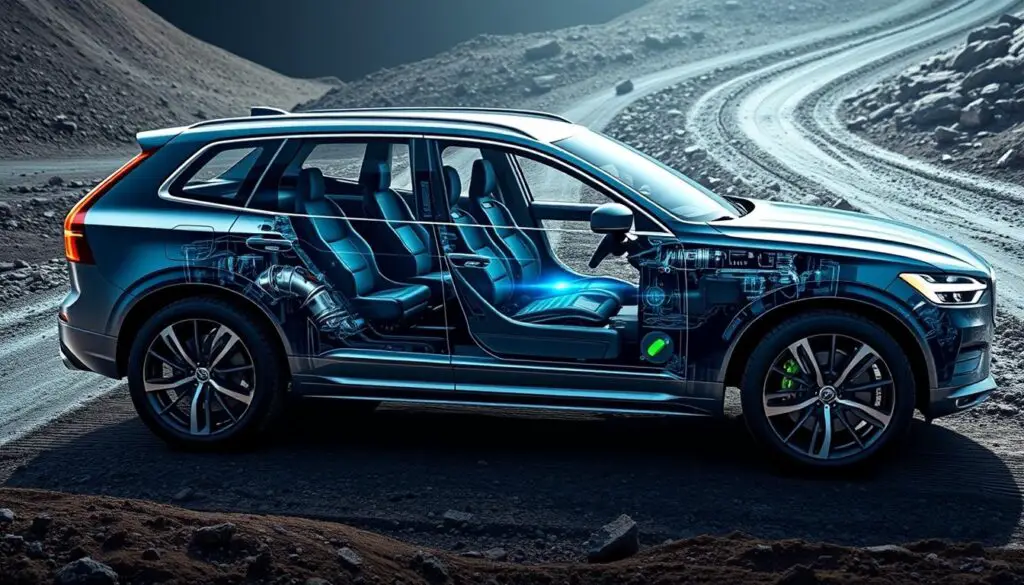
“Intelligent power and torque routing enhance confidence while protecting driveline components through precise control.”
| Function | How it acts | Driver benefit |
|---|---|---|
| Sensor monitoring | Scans throttle, brakes, wheel speed | Early slippage detection |
| Torque management | Limits power at slipping wheel, redirects torque | Maintains forward progress |
| Front-wheel bias | Routes most power frontward on dry roads | Better fuel economy and predictable handling |
| Hill Descent Control | Uses brakes and engine torque for steady descent | Low-speed control on steep or slippery declines |
How to drive with Instant Traction in changing conditions
Let steady throttle and calm steering give the car room to send power to the wheels that hold. Small, deliberate inputs let on-board control electronics sense grip and act without abrupt correction.
Snow and ice: maintaining grip on frozen and snow-covered roads
Apply smooth throttle so the drive unit can route torque among wheels. Maintain momentum on climbs and make gentle steering corrections to help the vehicle track straight.
On mixed winter surfaces, expect sudden grip changes at plow ridges or polished patches. Trust quick redistribution to stabilizse motion and keep a longer following distance.
Rain and wet pavement: reducing slip and improving control
Accelerate and brake progressively to allow control systems to stabilize the car during brief hydroplaning or localized slip. Preserve sightlines and extra space so the vehicle can translate traction into safe maneuvers.
Dry and light off-road surfaces: stability, Off Road mode, and low-speed control
On gravel or dirt, keep speeds moderate to limit wheel scatter. Engage Off Road aids when available for lower-speed calibration, and combine with Hill Descent Control on steep declines.
“With HDC active, modulate speed with the accelerator while the car uses brakes and engine torque to crawl down loose slopes.”
- Tires matter: seasonal tires expand safety margins and let the design perform as intended.
- Parts and maintenance: keep tires, brakes, and alignment in good order for optimum traction.
| Condition | Driver action | Expected benefit |
|---|---|---|
| Snow & ice | Smooth throttle, steady momentum | Balanced torque, better uphill tracking |
| Rain | Progressive braking and acceleration | Reduced slip, improved control |
| Light off-road | Moderate speed, Off Road/HDC when needed | Low-speed stability and descent control |
Volvo models and AWD options that feature Instant Traction
Several Volvo models offer a ready-built all-wheel drive system across body styles. This lineup covers SUVs, sedans, and wagons so buyers can match space and handling to daily needs.
Gasoline AWD lineup: XC90, XC60, S90, S60, S60 Cross Country, V60, V60 Cross Country, V90, V90 Cross Country. These models bring consistent drive logic and tuned chassis work for each platform.
The XC90 provides AWD with Instant Traction on every trim, giving families flexibility to choose features without losing capability.
The XC90 Recharge adds eAWD hardware. A battery and electric motor shift weight toward a low center of gravity and aid balanced weight distribution. Many eAWD vehicles offer an Off Road mode that uses an electronically controlled limited-slip function to help maintain progress at low speed on rough surfaces.
- Choose by use: space (XC90), nimble handling (XC60), long-haul comfort (V90) or sedan dynamics (S60/S90).
- Shop smart: review local inventory for towing packages, winter tires, or accessories that match your routes.
- Parts note: tire and brake choices affect how torque reaches the wheels and how the drive system performs.
“Design, chassis tuning, and AWD tech work together to deliver a composed car on highways and confidence on mixed surfaces.”
Ownership tips: getting the most from your AWD system today
Routine maintenance and smart habits preserve how your car directs power on mixed surfaces. Follow a few simple steps to keep traction performance high and avoid costly wear.
Service and driving best practices to preserve traction performance
Rotate tires on schedule so tread depth stays even. Even wear helps the system route torque predictably and prevents uneven handling.
Keep wheel alignment within spec. Proper alignment reduces premature parts wear and helps the vehicle track straight.
- Use season-appropriate tires; compound and tread matter more than you might think.
- Follow fluid and brake service intervals to preserve HDC function and overall system performance.
- Avoid prolonged high-speed wheelspin; steady throttle protects the driveline and saves fuel.
- Consider accessories like winter liners and secure cargo so added weight won’t upset balance.
“Small, regular steps extend component life and keep traction tech working when you need it.”
| Action | Why it matters | Result |
|---|---|---|
| Tire rotation | Even tread across corners | Predictable torque distribution |
| Brake & fluid service | Consistent modulation for HDC | Steady low-speed control |
| Warm engine briefly | Lubricants reach proper viscosity | Reduced wear when demanding power |
Read the owner’s manual for model-specific tips so you can use AWD features with confidence in local weather.
Conclusion
Volvo’s grip-management tech keeps power flowing to the tires that hold, so motion stays steady across quick changes.
This AWD system balances torque between front and rear to protect traction while preserving fuel efficiency on dry roads. Hill Descent Control and related control features add steady braking on slopes.
Choose models that match your needs — from three-row SUVs to wagons and sedans — knowing core benefits remain. Keep parts like tires and brakes in good order so the drive system can deliver intended performance and fuel gains.
For shoppers and a costco member comparison, review local inventory and test drive to feel the design and confidence firsthand. In varied conditions, Volvo AWD with instant traction helps drivers stay composed and safe.
FAQ
What does Volvo’s Instant Traction feature do?
Instant Traction quickly senses wheel slip and shifts torque to the wheels with the best grip. That improves stability and control on wet, icy, or loose surfaces while helping drivers feel more confident in varied U.S. road and weather conditions.
How does monitoring of throttle, braking, and wheel slip work?
Sensors continuously read throttle position, brake pressure, and individual wheel speed. The AWD control unit then analyzes that data in real time to decide where extra torque is needed to maintain traction and prevent a loss of control.
When does the system send torque to the rear or to individual wheels?
Torque redistributes the moment a wheel loses grip. During normal driving a front-wheel bias helps fuel economy. When slip appears, electronic clutches and torque-vectoring functions route power to wheels with better adhesion almost instantly.
How does Instant Traction work with Hill Descent Control?
On steep or slippery descents, Instant Traction cooperates with Hill Descent Control by managing torque and wheel braking to keep a steady, low speed and prevent wheel lock-up, giving precise control on rough terrain.
What benefits can drivers expect on snow and ice?
On frozen roads the system reduces wheel spin, improves launch traction, and stabilizes direction during turns. Combined with winter tires, it significantly raises confidence on snow-covered streets and highway ramps.
How does it help in heavy rain and on wet pavement?
Instant adjustments cut traction loss during sudden slip events, helping maintain line control and shortening the time the vehicle spends in an unstable state. That lowers the risk of aquaplaning-related drama when paired with good tires.
Is Instant Traction useful off pavement or on light trails?
Yes. In dry gravel or dirt, torque vectoring and Off Road settings improve low-speed control and reduce wheelspin. The system supports controlled momentum over uneven surfaces while protecting driveline parts.
Which Volvo models include this AWD capability?
Many Volvo gasoline AWD models offer this technology, including XC90, XC60, S90, S60, S60 Cross Country, V60, V60 Cross Country, V90, and V90 Cross Country. The XC90 Recharge eAWD adds electric drive advantages and an electronic limited-slip function.
Does the XC90 Recharge eAWD differ from conventional AWD?
The eAWD version combines electric motors and combustion power for faster torque delivery, a lower center of gravity, and improved weight distribution. That yields crisper traction control and an Off Road mode with enhanced electronic limited-slip behavior.
What routine service keeps Instant Traction performing well?
Regular maintenance includes scheduled checks of AWD fluids, brakes, wheel bearings, and tire condition/pressure. Software updates at a Volvo dealer ensure control logic stays current. Following the owner’s service schedule preserves system reliability.
Any driving tips to maximize traction performance?
Use proper tires for the season, keep pressures correct, and avoid aggressive throttle inputs on low-traction surfaces. Let the system respond rather than overcorrecting; smooth inputs allow electronics to manage torque distribution most effectively.